
Automating Client-Specific Server Deployments for a SaaS Startup
How BCT helped a growing SaaS company eliminate manual deployment bottlenecks, reduce reliance on DevOps, and speed up client onboarding with a secure self-service automation portal.
Client Profile:
This client is a software-as-a-service startup that deploys dedicated server environments for each new customer. Every sale triggered a hands-on provisioning and configuration process that depended on technical expertise and manual execution.
The Challenge:
Before working with BCT, the company relied on a DevOps specialist to complete the full deployment workflow for every new client. The process was functional, but it was slow, highly manual, and difficult to scale as sales increased.
Each deployment required:
– Manually provisioning a new server for the client
– Following a checklist to install dependencies and the SaaS application
– Generating and configuring API keys by hand
– Validating the environment before handing it off
Because only a DevOps expert could reliably complete the process, every new sale created additional pressure on a limited technical resource. What should have been a repeatable onboarding workflow became a growing operational bottleneck.
Request IT Service
We Manage Servers, Networks & IT Infrastructure.




























Why This Became a Problem
As the company grew, the deployment model began slowing the business down. Technical staff were spending hours on repetitive setup tasks instead of focusing on higher-value engineering work. Client onboarding timelines were longer than necessary, and the business faced increasing risk from process inconsistency and knowledge concentration in a single role.
The client needed a way to:
– Accelerate onboarding
– Reduce manual work
– Remove DevOps as a gatekeeper for every deployment
– Standardize deployments across clients
– Support growth without adding unnecessary operational overhead
The Solution
BCT designed and implemented a secure self-service deployment portal that automated the end-to-end server setup process.
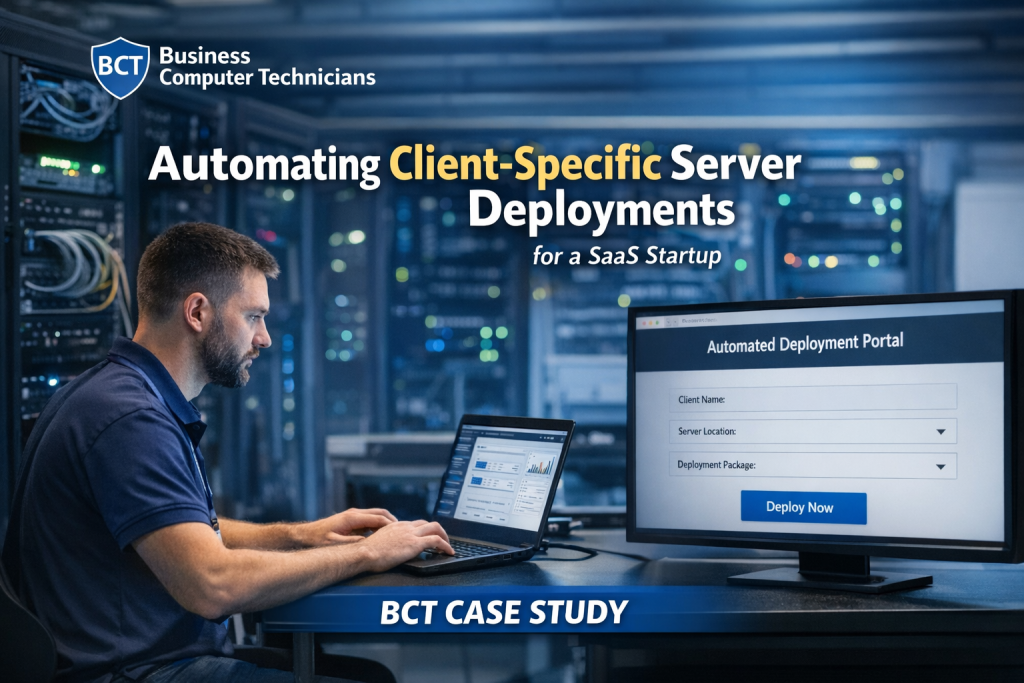
The portal allows sales and other non-technical team members to launch new client environments without needing direct DevOps involvement. Instead of relying on a specialist to manually complete every step, authorized staff can now follow a guided workflow and initiate deployment in just a few clicks.
Users can:
– Log into the portal securely
– Enter client-specific details such as server name, location, and client type
– Select from pre-configured deployment packages
– Launch the deployment from a simple interface
Behind the scenes, the system automatically:
– Provisions the correct server in the correct location
– Installs required dependencies
– Deploys the SaaS platform
– Generates and configures API keys
– Applies the required environment setup
– Completes the deployment workflow in minutes
Implementation Highlights
BCT focused on making the process both efficient and secure. The automation was built to reduce human error, enforce consistency, and make deployments accessible to non-technical users without sacrificing control.
Key improvements included:
– A structured self-service workflow for internal staff
– Standardized deployment logic based on client type
– Automated infrastructure provisioning
– Automatic software and dependency installation
– Secure API key generation and environment integration
– A scalable framework that supports future onboarding growth
The Results
What once took hours of manual work and required specialized DevOps expertise can now be completed in minutes by team members across the organization.
The business gained:
– Faster client onboarding
– No DevOps bottleneck for routine deployments
– Greater consistency across environments
– Reduced dependence on manual technical processes
– A more scalable onboarding model for future growth
By automating a critical operational workflow, the client was able to improve internal efficiency, free up technical resources, and create a smoother experience for new customers.
Business Impact
This project demonstrates how the right automation strategy can remove friction from technical operations without adding complexity for the team. Instead of scaling through more manual labor, the client can now scale through repeatable systems.
For SaaS companies and other growing organizations, this kind of workflow automation can improve delivery speed, reduce operational risk, and create more room for technical teams to focus on product and infrastructure priorities.
Services Related to This Case Study
– Workflow Automation
– Infrastructure Provisioning
– DevOps Process Improvement
– Server Deployment Standardization
– SaaS Onboarding Optimization
– IT Consulting & Solution Design
Need a Similar Solution?
If your team is losing time to manual provisioning, repetitive technical workflows, or onboarding bottlenecks, BCT can help you design and implement smarter systems that scale.
Request IT Service
Seattle Address:
651 Strander Blvd,
Suite 212
Tukwila, WA 98188
Seattle Support Line:
(206) 915-8324 (TECH)
Charlotte Service Area:
Charlotte Service Area
Charlotte Support Line:
(704) 727-4566

Read More IT Industry Insights & Tips
Stay ahead of the curve with expert analysis, actionable guides, and the latest news on business technology. Our blog is your resource for making smarter IT decisions and keeping your business secure and productive.
Multi-Cloud Identity, Logging and Backup Checklist
Standardize access, service accounts, keys, logs, alerts, backups, recovery, ownership, cost, lifecycle, and evidence across cloud providers.
AWS vs. Azure vs. Google Cloud vs. DigitalOcean for Business Workloads
Compare cloud providers by workload fit, identity, network, operations, backup, monitoring, support, skills, cost ownership, migration, and exit planning.
Juniper Network Lifecycle and Configuration Backup Checklist
Inventory Juniper devices, Junos versions, configuration, backups, rollback, firmware, support, optics, power, monitoring, and replacement plans.
Barracuda Email Security Checklist for Microsoft 365 and Google Workspace
Review Barracuda ownership, mail flow, DNS, connectors, policies, quarantine, administrators, logging, continuity, support, and lifecycle.
WatchGuard Policy and Security Subscription Review Checklist
Review WatchGuard Firebox policy, aliases, VPN, subscriptions, logging, firmware, backups, administrators, support, and hardware lifecycle.
How to Coordinate Sophos Firewall and Endpoint Security Administration
Connect Sophos Firewall and Sophos Central ownership, policy, endpoint, VPN, alerts, updates, logging, support, recovery, and incident workflows.